


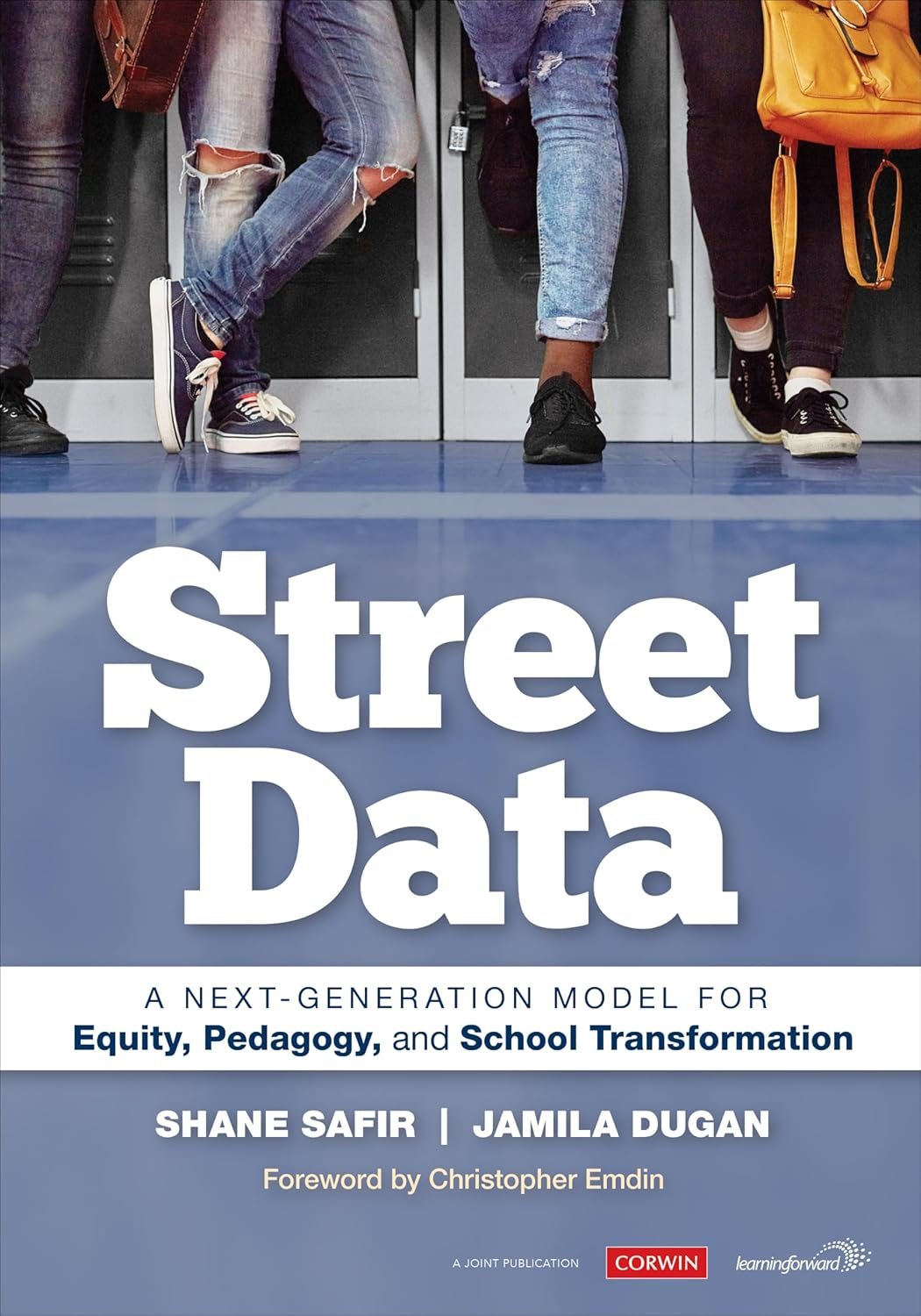
Radically reimagine our ways of being, learning, and doing
Education can be transformed if we eradicate our fixation on big data like standardized test scores as the supreme measure of equity and learning. Instead of the focus being on “fixing” and “filling” academic gaps, we must envision and rebuild the system from the student up―with classrooms, schools and systems built around students’ brilliance, cultural wealth, and intellectual potential. Street data reminds us that what is measurable is not the same as what is valuable and that data can be humanizing, liberatory and healing.
By breaking down street data fundamentals: what it is, how to gather it, and how it can complement other forms of data to guide a school or district’s equity journey, Safir and Dugan offer an actionable framework for school transformation. Written for educators and policymakers, this book
· Offers fresh ideas and innovative tools to apply immediately
· Provides an asset-based model to help educators look for what’s right in our students and communities instead of seeking what’s wrong
· Explores a different application of data, from its capacity to help us diagnose root causes of inequity, to its potential to transform learning, and its power to reshape adult culture
Now is the time to take an antiracist stance, interrogate our assumptions about knowledge, measurement, and what really matters when it comes to educating young people.
Publisher : Corwin
Publication date : March 9, 2021
Edition : First Edition
Language : English
Print length : 282 pages
ISBN-10 : 1071812718
ISBN-13 : 978-1071812716
Item Weight : 1.19 pounds
Reading age : 1 year and up
Dimensions : 7 x 0.64 x 10 inches
Best Sellers Rank: #23,049 in Books (See Top 100 in Books) #47 in Education Theory (Books) #50 in Education (Books) #139 in Sociology Reference
Customer Reviews: 4.7 4.7 out of 5 stars (581) var dpAcrHasRegisteredArcLinkClickAction; P.when(‘A’, ‘ready’).execute(function(A) { if (dpAcrHasRegisteredArcLinkClickAction !== true) { dpAcrHasRegisteredArcLinkClickAction = true; A.declarative( ‘acrLink-click-metrics’, ‘click’, { “allowLinkDefault”: true }, function (event) { if (window.ue) { ue.count(“acrLinkClickCount”, (ue.count(“acrLinkClickCount”) || 0) + 1); } } ); } }); P.when(‘A’, ‘cf’).execute(function(A) { A.declarative(‘acrStarsLink-click-metrics’, ‘click’, { “allowLinkDefault” : true }, function(event){ if(window.ue) { ue.count(“acrStarsLinkWithPopoverClickCount”, (ue.count(“acrStarsLinkWithPopoverClickCount”) || 0) + 1); } }); });


Britt –
A must read!
If you are in education, this is a must read! Fantastic perspective on equity and the model for education.
Tim K –
Good
Worthwhile read and a strong argument in favor of collecting data that is at the human, individual level. Schools are often caught up in looking at spreadsheets and colorful graphs that aggregate data from multiple students (usually entire buildings, districts, and states). But what information does that give you? Are you attuned to the experiential component of schooling? Can you disaggregate the data and see, listen, and feel how individual students are interacting with and understanding themselves as learners and people?The authors offer a compelling case that we need to spend more time collecting data and information by talking and listening to all stakeholders. You probably can’t make colorful graph with this data but it does give you a deeper and more meaningful sense of stakeholders’ sense of belonging, their sense of self, and their needs. Large data trends (“satellite data”) can help you identify problems and ask critical questions; street data allows you to put a face, an experience, and a person behind that data and humanize teaching and learning.
MCB –
Easy to understand and practical
Easy to understand book about data and how to use it!
Paula Sanders Blackwell –
Great Book!
This is a great book about the transformation that is needed in every school. I loved their model and the way even a kid could clearly understand the need for change in our schools.
Daron –
Good book seller
Brand new book! Exactly what I ordered!
Natalie Bailey –
The latest cutting edge classroom data
Excellent read!
LAH –
this is the book I am using ALL the time; transformative
Street Data shares a systems-based leadership model and strategies to “walk the talk” of truly transformative school and district transformation. As someone with 25+ years experience in education as a teacher, school building leader, and district leader, this book is the handbook I am going to be referring to often. Safir and Dugan name powerful truths about how we often make decisions without listening to those who are most marginalized in our school systems. This book includes a powerful structure supported with specific practices and examples that avoid a cookie cutter one-size fits all model. Street Data bridges a cohesive equitable school transformation that is both visionary and sustainable. I strongly urge all district and school administrators and teacher leaders to read this book.
DP –
Tries to justify an irrational, antiscientific, and bigoted worldview
I was shocked by the irrational, anti-scientific diatribes that were made in the epistemology section, and shoot through the book. It makes no attempt to analyze the historical causes of the use of science to justify bigotry, just mentions that it happened, then throws out the baby with the bathwater in terms of the epistemological underpinnings of science. Furthermore it makes no mention of the fact that science is not belief set but a continuous process that self-corrects.It is racist and disturbing that a philosophy, which on its own has no race, has been attributed to a “white” or “western” worldview. This is demeaning to the Underprivileged for whom science and reason was the source of liberation from bigotry, superstition, and inspires the fight for equality and freedom.The Book cites pseudo-scientific, bigoted, and right wing efforts, which are rightly condemned, and concludes that Science is the problem! No mention of the fact that it was Science that ultimately helped to undermine bigoted theories. No mention of the fact that Science and Reason are products of the philosophical movement that brought down Aristocrats and Monarchies, which fought for the belief of natural inequality and its own privilege. The philosophy of the Kings and the philosophy of the authors have more in common with each other in their intellectual development than either have to do with the philosophy of science, rationality, or freedom.In recent years, the postmodern equity industry has itself touted pseudo-science in the form of the implicit bias test, which in several studies with sample sizes in the thousands, repeatedly concluded that so-called “implicit bias” has “no impact on outward behavior”. The Implicit Bias test was even denounced as being misused by one of its creators. Of course in dealing with humans, children, and people, it is necessary to take into account decency, be tolerant of differences, and actively listen to needs. But this in no way justifies a fundamental shift in epistemology. The teaching of intrinsic difference, is right wing, is not progressive, and will Reify division and difference. Science and Reason have become the backbone of the anti-bigotry that has massive popular support. The forms of anti-bigotry that reject the philosophy of the Enlightenment and Scientific Revolution, have historically, and are presently, being used to undermine the achievements of previous struggles for Equality. The philosophical arguments used to justify the book’s ostensible worldview, are indistinguishable in content from the arguments used by Nazis and Neo-Nazis. Read “The Seduction of Unreason” by Richard Wolin. It holds a mirror to the worldview and philosophy that defines this book.
Derek S. –
This book is the key to teaching through an equity lens. If this book doesn’t make you think everything you think you know about education, nothing will!
Dee –
Great book and useful for furthering one’s understanding of the change that is needed.
Jessica Cowling –
Not worth your time or money